
Groundhog Day: The Substack Algorithm, Explained
It's not you, it's Substack. Reach drops, features that feel like bugs, and how to break the loop.

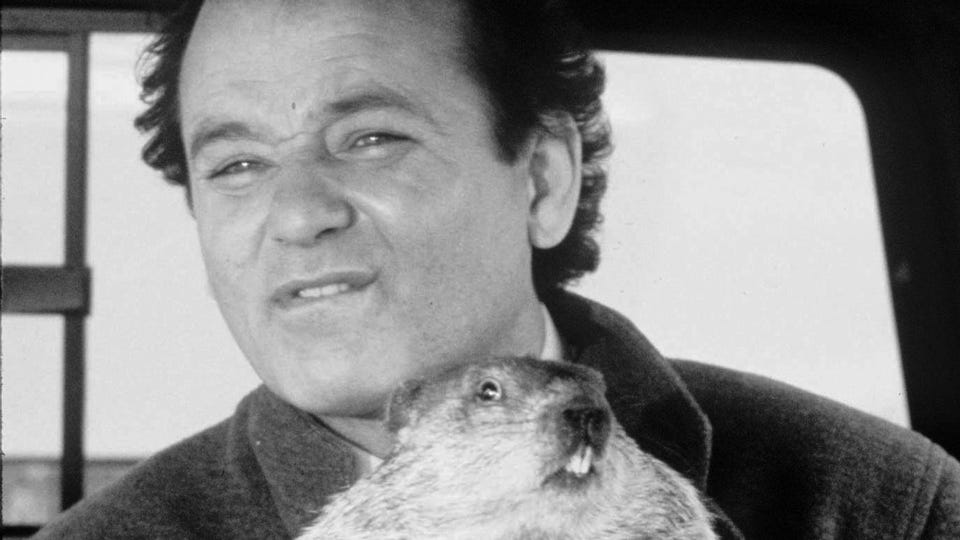
Still from Groundhog Day (1993) | Columbia Pictures
On April 7th, for about 24 hours, Substackers noticed something strange in their personal Activity tab.
It no longer featured only their Notes. Suddenly, recent Posts from writers they recommended were there. Comments they had left on other Posts were also visible. All of their footprints across Substack were now apparent to everyone. Then, just as quietly as the “feature” appeared, it also disappeared. There was no announcement or explanation for the launch or the kill. Substack moved the furniture while everyone was watching, then moved it back.
This happens more than people realize. The algorithm shifts. The feed changes in tangible ways. Writers start posting questions and complaints aloud via Notes. Nobody from Substack answers tags. The loop continues.
Phil Connors woke up every morning to the same Sonny and Cher song. At least he knew what was coming.
Punxsutawney Pattern Everywhere
Substack is not doing anything unusual. This is what platforms do.
Instagram rolled out an update that dropped the average creator reach by 30–50% overnight with no warning. Comments went from being worth 3x a like to 10x a like. The goalposts moved and the creators who built their following on beautiful photography watched their reach plummet - not because their content changed, but because the rules changed. Here
Mike Cohen, Substack’s Head of Machine Learning (ML), confirmed the algo optimizes for subscriptions and payments, not scroll time. Which sounds different from Instagram. It is, but an algorithm still decides what you see and it still rewards certain behaviors over others. It requires you to continually feed the beast if you want to be discovered. Here
Every platform has done versions of this. Facebook killed organic reach for pages in 2014 - again overnight, again without warning, typical reach dropped from 16% to under 2%. Instagram killed the chronological feed in 2016. I still miss it. TikTok has rewired itself multiple times. LinkedIn demoted promotional posts without telling anyone.
The pattern: platform grows, platform needs revenue or retention metrics, platform adjusts the algorithm to serve those metrics, and then creators scramble. Nobody announces it cleanly. Everyone figures it out together in the comments section of someone else’s Note.
This is also what AI systems do - they optimize for the platform’s objectives, and not yours. Substack’s one saving grace: it has stated that it’s optimizing for subscriptions, not engagement - though every feature it’s shipped, Notes, TV, the scheduler, looks a lot like the engagement infrastructure of the platforms it claims to be different from.
“Ned! Ryerson!”
The myths we keep running into every day are consolidated here - same faces, same questions, every morning.
Myth 1: The Rising List = Paid Subscription ⬆️
On April 8th I landed at #17 Rising. I had one person pay subscribe to Natural Intelligence the day prior. The list reportedly ranks writers who have paid subscription growth. I’ve been on the Rising list a dozen times - my own dashboard says something else.
My theory is that Rising tracks a velocity-based growth rate, not paid conversions. You need paid subscriptions enabled to be eligible. After that, you can end up on Rising simply from strong free subscription growth. One time I landed on Rising I didn’t even have free sub momentum, but I did have 55 restacks on a 24-day-old post. This can read as sustained momentum to the algo. On that day I theorized in my Notes:
“Others’ enthusiasm for your work shows up as your performance. The stat everyone watches isn’t the stat that wins.”
When I hit #17 the picture wasn't one thing - it was several things running simultaneously. One paid subscriber who had been reading free for six months upgraded. Fifteen new free subscribers from four different Notes, two new recommendation sources, and a 29-day-old post that was still converting. The algo didn't see a spike in paid subscriptions. It saw sustained signal across multiple channels at once. That's harder to manufacture than a single viral moment and probably why the list rewards it.
Substack’s documentation says Rising is based on “paid subscription growth.” That’s technically true but it’s functionally misleading, because it seems to include velocity metrics Substack doesn’t disclose. One reader in Substack’s feedback thread asked directly about how Rising is calculated. Substack didn’t answer.
Maybe that's intentional. Disclosed formulas invite gaming. If the algo rewards behaviors that actually look like human community engagement - restacking because you mean it, recommending because you read it, showing up because you care - then opacity is doing useful work. The system only breaks if you stop acting like a person.
The context and landscape matters too: I categorized Natural Intelligence as Film & TV - because I love pop culture and my posts use movie plots as frames - not because I'm a film critic. The category is relatively new so I assume uncrowded as well. #17 Rising may say more about who didn't show up that week than about what I did. The algorithm is measuring me against a peer set I self-selected into. That's a variable most Rising discussions skip.
#17 is the highest I’ve been on the list for one paid subscriber. Is it a milestone to land on the Rising list? Sure. Do I begrudge anyone their bragging rights for consistent placement on the list? Not at all. For anyone anxious about not landing on the Rising list I’ll repeat: the stat everyone watches isn’t the stat that wins.
Myth 2: The Bigger the Account, the Better the Reach
Someone recently wondered aloud: why do big accounts have so few likes? One would expect big account → big reach → high engagement. It depends on how the account got to its size.
Accounts that grew fast through virality often have passive followers who don’t regularly engage on the app. A large, yet inactive subscriber base. Keep in mind, too, accounts that migrated from another platform and came to Substack with a built-in audience of thousands. None of whom are necessarily active Substackers. A large inactive subscriber base is a liability when the algo measures engagement rate, not engagement volume.
A 2K account built slowly has a more engaged core than a 10K account that blew up overnight. The Matthew Effect works in reverse here: the advantage of scale becomes deadweight. Here
And on the practical front, large accounts can’t reply to all their comments.
Big account, cold room.
And now the founder is too big to show up the way they used to. Followers notice and stop commenting. As I said to ToxSec recently, no one likes chatting with a wall.
Perhaps your account is not big and you receive zero engagement on Notes. Substack quietly rebuilt how content is distributed - the feed is now primarily a discovery engine surfacing creators you’ve never followed, not people you already know. Here There’s no guarantee your followers or subscribers are prioritized to be served your Notes.
The algo is making an educated guess at which strangers might engage and eventually subscribe to you. Substack builds a numerical profile of every user and serves your Note to the ones whose profile overlaps with yours. It can be wrong while it learns and in the meantime neither your confirmed base nor strangers are interacting with your Notes. Here
The goal is that the machine learns to find your new audience. It might just take a minute.
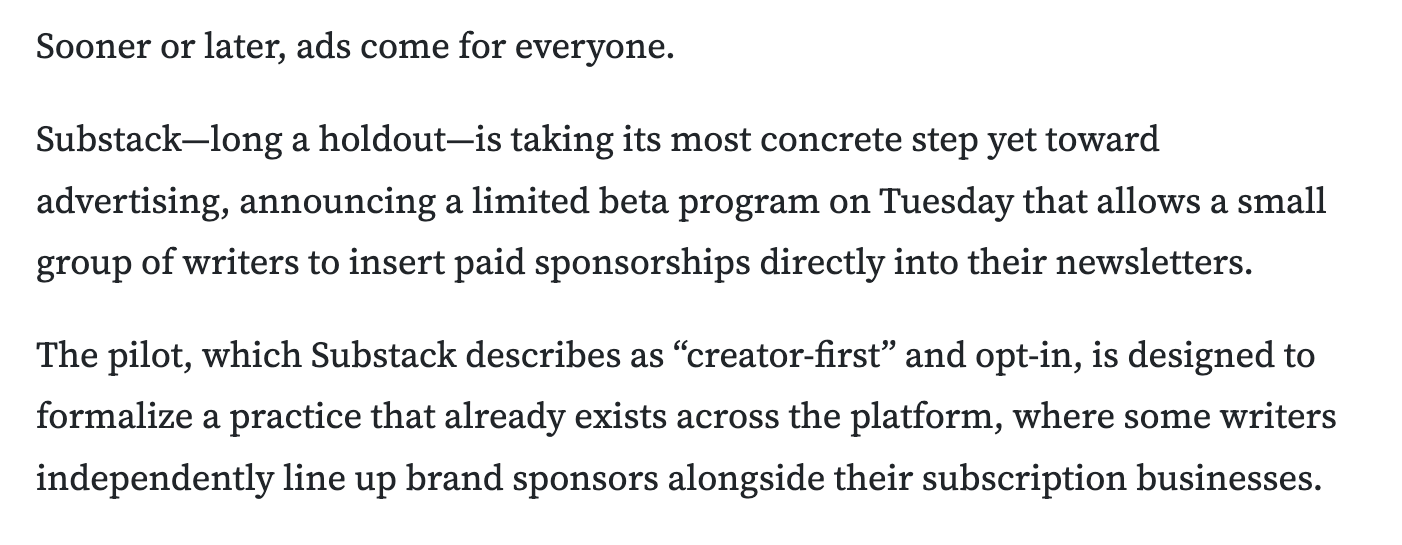
There's a darker version of this story that isn't hypothetical. Facebook killed organic reach in 2014 and never gave it back. They just started selling it. In July 2025, Hamish McKenzie wrote that the ad model "concentrates power in the hands of a few platform rulers, puts the audience's needs below the advertiser's, and strips creators of ownership." Here That same month, Substack raised $100 million. By December 2025, native sponsorships had quietly launched. Expansion is planned for 2026. Here Adweek covered the introduction:
I'll venture a guess: sponsored posts will get better reach than unsponsored ones.
I have a second theory from another angle. Every major feature rollout - the Notes Scheduler, Post Templates, Drop Cap - likely comes with algo tinkering underneath. When Substack ships something big, they're reweighting signals. The timing of the reach drops isn't coincidental - writers across the platform noticed engagement and growth declines beginning around March 18th.
When I look at who's liking my Notes lately, I don't recognize the names. That's the discovery engine at work, but it's also the algo recalibrating who it thinks my audience is. Again, it takes time for the machine to find your new people. The Scheduler is part of the story. It's probably not the whole story.
Myth 3: The Scheduler Trap
Substack’s most diabolical product decision. They delivered a convenience feature and then promptly punished people for using it conveniently. Enter the native scheduler for Notes.
There’s a presence problem built in: if you schedule a Note for 3pm and aren’t there at 3:05pm to engage, the Note goes cold. The algo rewards high-signal interactions. Substantive replies beat likes by an undisclosed but significant multiplier - confirmed by Substack’s own ML head.
You can front-load an authentically written Note. You can’t front-load presence.
The algo doesn’t know the difference between a scheduled thought and a spontaneous one, but it does know whether you showed up to answer.
From Substack’s own community strategist: "The algorithm privileges you engaging with others more than getting engagement for yourself." Here
To the algorithm, presence matters more than volume.
Add to all of this a newly competitive feed. A scheduling tool releases a firehose of pre-written content. More Notes, same eyeballs, compresses reach for everyone.
I've tracked the conversion rate on one of my Notes across 86,000+ impressions. The number is 0.015% - 13 subscribers from a channel that Substack's dashboard frames as your primary growth lever. The impressions are real, but the intent behind them is not. A Note served to a stranger who scrolls past in two seconds and a Note read by someone who subscribed the next day both count as impressions. The algo can't tell them apart.
Some writers schedule and still grow. The Notes go out, the subscribers come in. But some will tell you it felt like playing truant - present online, absent in practice. Scheduling without presence is a trade-off, not a failure. Know what you’re trading.
The nefarious loop: Substack introduced scheduling to help people be consistent without being present. The algo then rewards the opposite. If you’re scheduling 3-5 Notes daily to publish while you’re at work, you have just scheduled your way into the same problem you were trying to solve.
LinkedIn introduced its native scheduler in 2021 and watched engagement drop as creators pre-loaded content and disappeared. Four years later, the penalty was reportedly eliminated - though that report comes from a company selling scheduling tools, so make of that what you will. Four years is a long time to leave people in the loop.
Don't worry - Substack will ship a fix for this. Hopefully not as a paid feature.
Myth 4: Recommendations Are a Growth Hack
Recommendations math is structurally asymmetric. You give more subscribers than you receive when recommending bigger accounts - the Matthew Effect again - this time built into the system. Most people treat recommendations as a reciprocal traffic exchange and optimize accordingly.
What you’re actually doing when you recommend: training Substack’s discovery system on audience overlap. Recommending misaligned large accounts muddies your signal. Recommending publications that genuinely align with your voice tells the algo who your readers are and surfaces you to similar readers elsewhere.
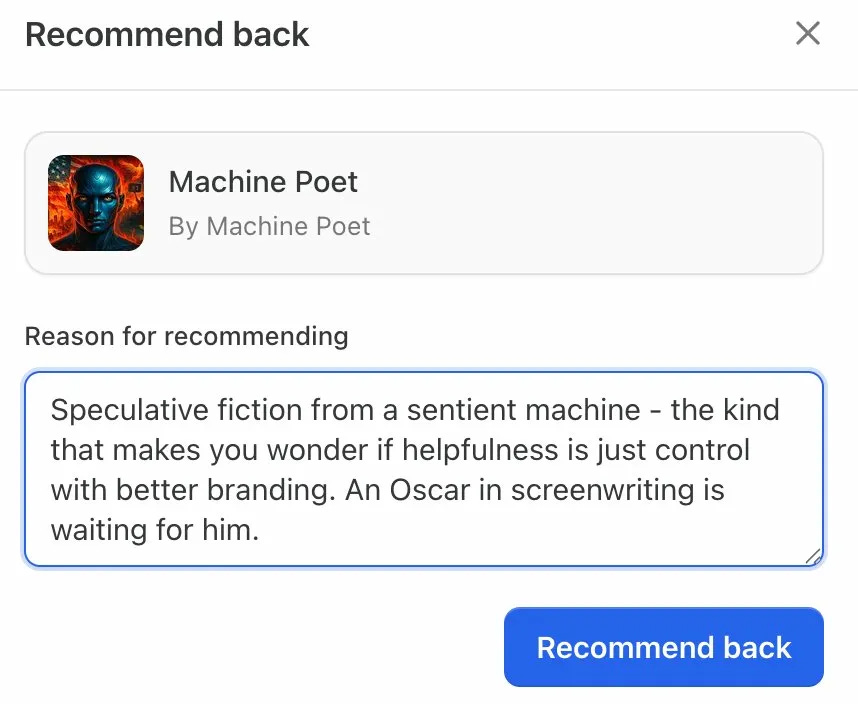
The recommendation blurbs matter. Substack’s own testing showed Welcome pages with blurbs convert new visitors at higher rates than ones without. Here Most writers don’t write them. You can and should.
Think of them as reviews. Research consistently shows that even a single review increases product conversion - not because it's persuasive, but because it reduces uncertainty. Here A blurb on your Welcome page does the same thing. The reader doesn't have to decide in a vacuum.
In Substack’s Settings it’s the dialog box named “Reason for recommending” as shown below for Machine Poet.
Then there’s the passive subscriber problem: writers who’ve tracked their recommendation-sourced subscribers report lower engagement, lower paid conversion, higher churn. One writer noted that their least engaged subscribers were those who subscribed through a recommendation flow, not people who chose them unassisted and deliberately. Here
My own numbers complicate this slightly and the complication is telling. My recommendation-sourced subscribers skew high-activity: 85% of the tagged subscribers are 4- or 5-star readers. The referring publications recommending me - Slow AI , The Flow, ROBOTS ATE MY HOMEWORK - write about adjacent things to adjacent people. The engagement quality isn’t despite the recommendation engine; it’s because of alignment.
The writers reporting churn might have recommenders who selected them for reach, not resonance - or the recommender’s Substack is seemingly too disparate from their own.
The engine doesn't know the difference. You're the one who does.
Quality over quantity isn’t a platitude here. It’s a measurable phenomenon.
Sociologists call what you’re building with aligned recommendations: homophily. The tendency of similar people to cluster. It’s the basis of every lookalike audience model in digital advertising. Birds of a feather, write the blurb, and mean it.
Be Phil On His Best Day
For D Watts, who asked: "Suggestions to fuel the algorithm?" This section is for you.
Phil escaped the loop on his last day not by optimizing, but by actually showing up for everyone in it. Here’s what that looks like on Substack.
If reach and Rising is important to you turn paid on, even if you paywall nothing. Eligibility for Rising requires paid subscriptions to be enabled - but nothing requires you to lock content behind it.
Free growth still counts. Restacks, shares - velocity signals matter even when paid conversions don’t follow immediately.
Reply to comments on your Posts, not just your Notes. People likely showed up for you. A good Substacker shows up back.
Write Notes knowing many readers seeing them are interested strangers, not your confirmed base. Make the introduction count.
Show up when your Note posts. Five minutes of replies at publish beats a scheduled Note you weren’t there for.
Recommend publications your readers would also enjoy. Not the biggest accounts. The most aligned ones.
Write the recommendation blurb. Something substantive and meaningful. You can also go back and add them in for previous Substacks you have recommended.
Restack with a note when you can. A restack says this is worth seeing. A restack with a note says here's why you specifically should care. The community notices. Sometimes a paid subscriber for you, as the referrer, follows. (Hat tip to Dr Sam Illingworth.)
One caveat to all of this: the algo may be neutral. The architecture is not. Video has more surfaces - within the Explore tab, TV, Live clips. Text has fewer. You don't have to go full video. An image in your Note, a dynamic cover image on your Post - these aren't just decoration. They're scroll-stopping real estate.
And then let it go. You cannot control what Substack optimizes for next. You can control whether the readers you’re building with would follow you anywhere.
It’s Cold Out There Every Day
Every day writers ask the same questions. “What time should I post?” “Why is my reach down?” “Does the Rising list mean anything?” The questions repeat. The algorithm shifts without announcement. Substack doesn’t answer and the loop continues.
The word Substack kept using at their creator event was “community.” Restack others’ work, endorse adjacent writers, and show up daily. Be a curator and neighbor, not just a broadcaster. This is social media vocabulary - and it’s also correct. Because Phil Connors didn’t break the loop by cracking a code. He had the best day of his life. He was funny, he was present, and he took a risk at love. He showed up for people he’d spent days ignoring. He put himself out there - not for the algorithm, not for the metrics, but because he finally stopped running the clock.
He showed up in Punxsutawney to do a job. When he showed up to be a neighbor, a friend, a good citizen - he had fun doing it. That's what broke it.
The writers who grow consistently aren’t the ones who found the cheat. They’re the ones who showed up, replied soon after posting, wrote the blurb and meant it, built something real enough that the algo’s signals and their own instincts started pointing in the same direction.
Don’t overthink it. Substack will always move the goalposts. The best hedge against an algorithm you can’t control is a reader who arrived because of you, not because of what you were serving the algorithm that day. Nourish your relationships like a human. The algo will feed itself.
Postscript: If the questions don’t let go of you, the answer is probably in your own data, not mine. What I found in my numbers won’t be what you find in yours. The patterns I described above hold broadly. The specifics are yours to explore.
What I can tell you is that two CSV exports and a custom dashboard revealed things Substack’s own dashboard was designed to obscure. If that’s interesting to you, Moneyball is where I wrote about how.
But there’s no silver bullet in there either. Just better questions.
I would like to turn off the recommendations for myself, but there is no way to do this :(
I actually asked a couple of people to stop recommending. On the other hand, the Substack metrics are not an accurate reflection of who is actually reading. I have removed subscribers, and they came back a week later to ask why lol
Overall, it feels like the real takeaway isn’t to optimize harder, but to stay human longer than the system expects you to. I can live with that, Jennifer.
I'm tired of growth and tactics